Building agents at Gimmie AI has changed the questions I ask before I trust an automation. Where did the evidence come from? What was the system allowed to change? If execution stops halfway through, what happens next?
What’s Gimmie AI? We’re a gifting e-commerce startup based in Austin.
Here, we help people discover thoughtful gifts and find something that fits the person they’re shopping for. I work on the AI systems and automations that support our product and go-to-market efforts.
Our go-to-market work spans account research, email, content, and follow-up. I have used LangGraph, worked with OpenClaw and Hermes, built n8n automations, and used Latitude to inspect agentic tool calls. Connecting those tools to business systems made the boundaries between them more interesting to me than any individual framework.
Consider a familiar request: research an account, prepare a useful message, and put it somewhere a person can review it. A model can help with the research and writing. The surrounding software has to preserve the evidence, manage review, and account for anything that changes outside the workflow.
These are the design principles I would carry into the next system I build.
Define completion before choosing a framework
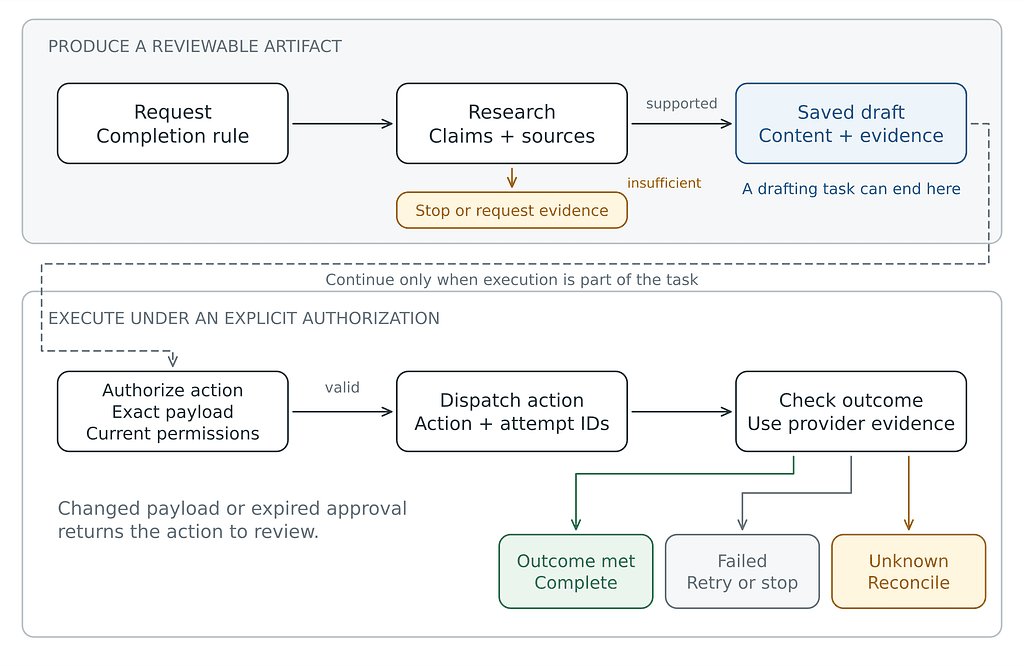
For an account brief, completion might mean a saved document with source references, a relevance assessment, and an explanation of what remains uncertain. For an outreach workflow, completion might mean that the exact message a person approved was accepted by the email provider. Those are different contracts. Neither establishes that a recipient read the message.
Writing down that distinction changes the implementation. Research can return insufficient evidence. Drafting can finish while review remains pending. An external action can be accepted while its eventual delivery is still unresolved.
The model can handle the parts that need interpretation: choosing a useful source, identifying relevant context, or explaining a recommendation. Code should enforce the parts with explicit rules, such as required fields, permitted tools, and execution limits. A schema can check that a source reference exists; whether that source supports the claim still needs an evidence check.
This is where the distinction between workflows and agents becomes useful. Anthropic describes workflows as predefined control paths and agents as systems where the model directs the process. A single application can use both. The choice depends on where flexibility improves the task enough to justify its cost.
Make state describe what actually happened
The data model deserves attention before the workflow grows. A single field called `status` quickly becomes ambiguous when it has to describe research, review, execution, and delivery at once.
The separation has a practical consequence. If a draft is saved but its review notification fails, the next step can retry the notification without generating another draft. A person inspecting the run can see both facts.
Approval needs the same precision. In this example, it binds to the operation, account, recipient, and complete message payload. One implementation is to store an immutable payload and compute a digest from a canonical representation. The executor compares the current action with the approved version, checks expiry and current permissions, then dispatches that same immutable payload. A digest detects changes; access controls establish who is allowed to approve.
The model should not be able to grant itself approval by returning `approved: true`. The application records authorization through a trusted review path. Some low-impact tasks can instead use an explicit standing policy. The permission should remain scoped and checkable either way.
Give each run one logical owner
LangGraph helped me think about state and transitions. n8n gave me a useful way to handle triggers, routing, and predictable data movement. Working with OpenClaw and Hermes brought another question into focus: which component is responsible for the run when work crosses runtime boundaries?
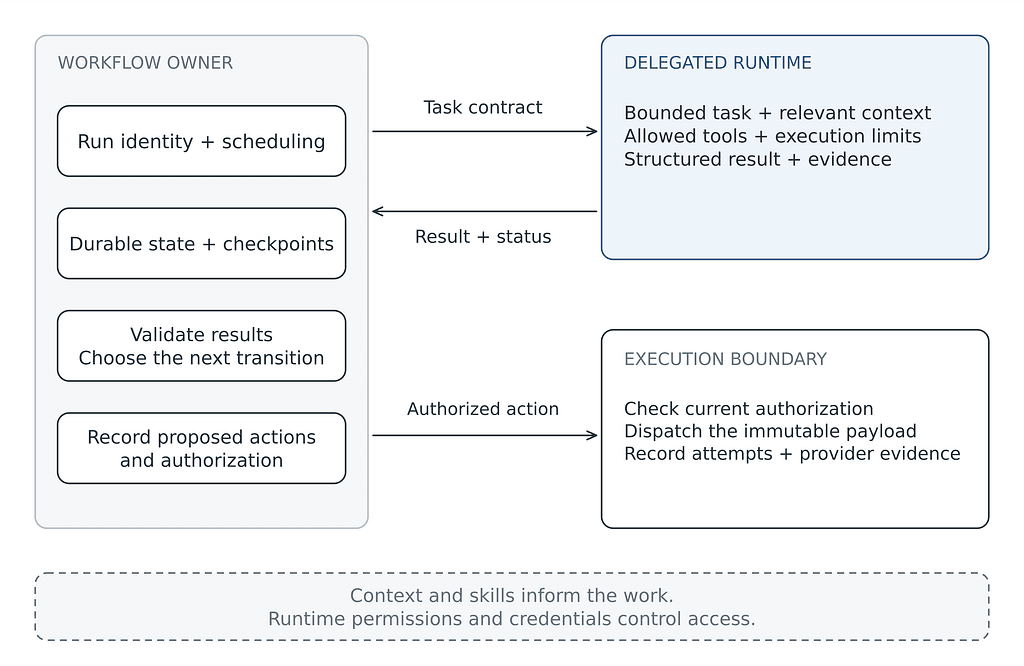
In this design, one logical owner handles scheduling, run identity, and authoritative state. A delegated runtime receives a bounded task and returns a structured result. The owner validates that result before advancing the workflow. This is an application design, not an assumed integration between those tools.
For an account brief, the delegation could specify the account, permitted sources, tool permissions, output schema, and a time or cost budget. The return value should distinguish a completed brief from insufficient evidence, a tool failure, or a reached limit. A parent workflow can respond to those conditions without interpreting a closing paragraph as a control signal.
This surrounding software is the agent harness: the code that supplies context, exposes tools, manages execution, and preserves progress. Anthropic’s work on long-running agents provides a useful example of explicit progress artifacts helping later sessions continue unfinished work. The exact artifacts depend on the task.
Business workflow state needs a durable record outside the model’s conversation. LangGraph’s documentation distinguishes checkpointed thread state from information stored across threads, and warns that in-memory checkpoints disappear on process restart. The persistence backend is an operational choice.
A remembered writing preference belongs in context. Current authorization belongs in the permission system. A retrieved page or reusable skill can inform a task without gaining the ability to widen its permissions.
Make context specific to the job
A research task needs source access and a way to record uncertainty. A writing task needs the approved brief, examples of useful messages, and the editorial rules. Giving each step relevant context makes its behavior easier to assess. Distinct roles can be configurations of one runtime; they do not automatically require separate agents or infrastructure.
A skill can capture a repeatable procedure: which sources to consult, what to produce, and how to verify it. The runtime still enforces tool access and resource limits. A skill file that says “do not send” is guidance; withholding send credentials from that worker is an enforceable boundary.
Skills and configuration also need review as they accumulate. Two individually reasonable instructions can conflict when loaded together. An agent can propose a memory update after a run, but its own assessment is insufficient evidence of improvement. Corrections need provenance, an appropriate scope, and evaluation before they alter shared behavior.
Treat external actions as a separate execution problem
Tool interfaces need to describe their effects precisely. Saving a local artifact, creating a provider-side draft, and sending a message should be distinct operations with distinct permissions. An adapter should normalize provider responses into explicit statuses, and integration tests should check the resulting provider state.
For consequential writes, I would use an execution service that checks authorization immediately before dispatch. Credentials and network access must support that boundary. A check in one helper offers little protection if another script can reach the provider directly with the same credentials.
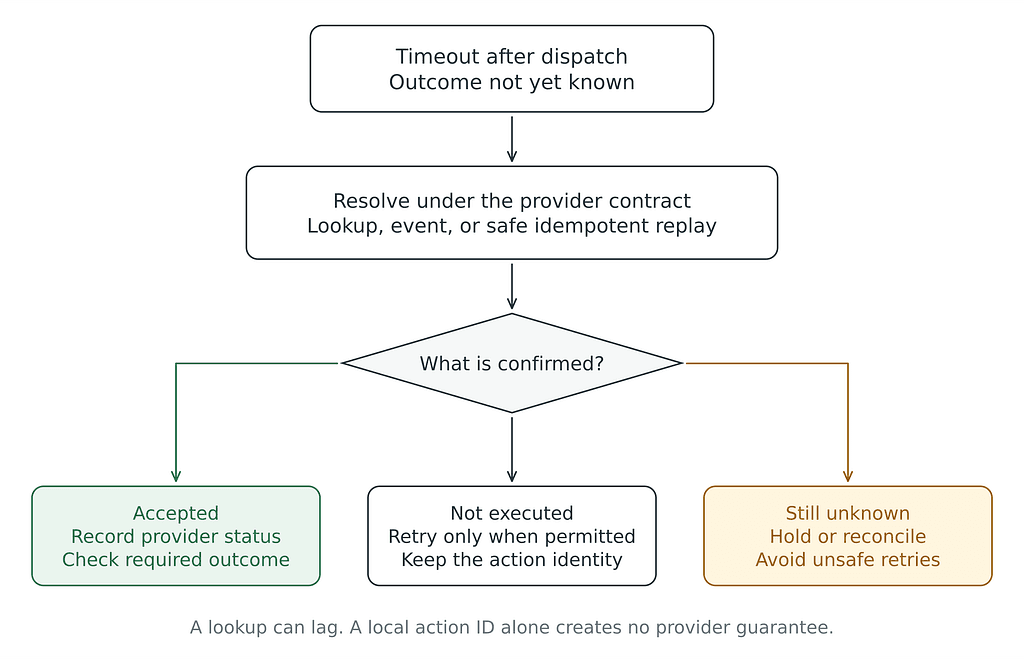
Recovery becomes especially important when the response is missing. Suppose a provider accepts a message, but the connection drops before the worker records the result. The worker knows that it attempted the action. It does not yet know whether repeating it would create a duplicate.
The action keeps its identity across retries; each attempt gets a new identity. Provider idempotency, where supported, uses a stable key for the same intended operation. Its guarantees come from the provider’s contract. Stripe, for example, documents parameter matching and key retention behavior. A key reused after removal can create a new request.
When the provider supports a reliable status lookup, use it. When it guarantees safe replay for the same key and payload, a retry may resolve the uncertainty. Otherwise, preserve an unknown outcome and reconcile or request review. An empty lookup result is not proof of non-execution if the provider’s records can lag.
AWS’s discussion of safe retries explains why expressing request identity in the API contract matters. Client-side tracking and provider-side behavior have to agree.
A transactional outbox can keep a committed action from being lost between a database write and dispatch. It does not, by itself, prevent the provider from applying a repeated request. Likewise, a checkpoint helps resume local work but cannot settle an unknown external outcome.
Measure the workflow at its boundaries
Latitude made tool calls a useful place for me to inspect agent behavior. In this design, the trace should connect the run, artifact revision, authorization decision, and each external attempt. Tool arguments and results need selective capture, redaction, and access controls; storing every raw payload creates its own problems.
The record should answer an operational question. Did research produce usable evidence? Did validation reject the draft? Is the run waiting for a reviewer, or did the notification fail? Was the action accepted, rejected, or left unresolved?
Those distinctions also make evaluation more useful. For the account workflow, I would start with ordinary examples and a small set of difficult cases:
- Sources disagree, and the brief must preserve the disagreement.
- The message changes after approval, so execution must require fresh authorization.
- The same job arrives twice, so it must not create two logical actions.
- A provider accepts the action before the connection drops, so recovery must respect its actual retry guarantees.
Use deterministic checks for properties such as schema validity and approval matching. Assess relevance and evidence support with a defined rubric and reviewed examples. Model-based grading can help, but its agreement with human judgment needs checking.
Anthropic’s evaluation guidance makes a useful distinction between the agent’s recorded execution and the final state of the environment. It also recommends repeated trials because an agent can behave differently across runs. Those are useful foundations for testing the whole workflow.
For a drafting workflow, I would track acceptance without edits, reviewer time, and total operating cost per accepted artifact. That cost includes unsuccessful runs. Coverage matters too: how many eligible requests produced a useful result. Otherwise, a system can appear more reliable simply by declining difficult work.
Release the behavior together
A prompt change can affect production behavior without changing the container image. The release therefore needs a manifest connecting the code version to the workflow, prompts, schemas, tool adapters, model configuration, and permission policy. Each run records which release it used.
That makes investigation possible, though it does not guarantee exact replay. Models can vary, provider services can change, and source data can disappear. Saving the relevant input versions or permitted snapshots helps explain a result later.
Long-running work adds another concern: an older checkpoint may not fit a newer state schema. A deployment needs an explicit decision to finish those runs on the old version, migrate them, or stop them for review. Rolling back the worker image alone may not restore compatible behavior.
I would test restarts at the boundaries that matter: after saving an artifact, during an approval wait, and around dispatch. With several workers, conditional state updates or fencing tokens can reject stale writes to the database. External duplicate prevention still depends on the execution design and provider contract.
The initial deployment can be small. A service, durable database, and background worker may be enough. Separate credentials, bounded retries, and a control that stops new external writes matter earlier than a large cluster. Kubernetes becomes useful when its scheduling or operational capabilities solve a measured need.
Stay with one workflow long enough to learn
New agent products keep changing what is easy to build. I want to keep exploring them, but I also want enough continuity to understand the work they are doing.
For an account brief or inbox review, I would keep the input, useful output, and review boundary stable while improving the implementation. That makes it possible to compare a new model or runtime against the same examples, permissions, and recovery requirements.
The decision to adopt another tool then becomes concrete. Can it express a handoff more clearly? Reduce reviewer effort? Recover interrupted work with fewer manual steps? Does that improvement justify the migration and ongoing maintenance?
That is the engineering judgment I want to carry forward from Gimmie AI: choosing where reasoning earns its cost, making authority explicit, and keeping enough evidence to know what happened after the model stopped speaking.
— Anudeep Adiraju